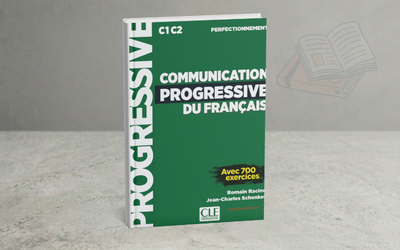
Communication Progressive du Français C1-C2
The Ultimate Advanced French Communication Book for True Mastery
When you reach an advanced level in French, most conversation books start to feel too easy. Everyday dialogues no longer challenge you, and the language you produce still lacks the precision, elegance, and cultural depth of a near-native speaker. This is exactly the gap that Communication Progressive du Français C1-C2 was designed to fill.
Written by Romain Racine and Jean-Charles Schenker and published by CLE International, this book is the highest level in the well-known Progressive series. With 700 carefully crafted exercises, authentic literary and journalistic texts, complex communicative tasks, and strong preparation for the DALF C1 and C2 exams, it is one of the most complete and ambitious resources available for advanced learners.
Who Is This Book For?
This book is ideal for:
- Learners who already have a solid B2 or C1 level and want to reach true C2 mastery
- Students preparing for the DALF C1 or C2 examinations
- Professionals who need to communicate at a high level in French-speaking environments
- Teachers looking for rich, culturally deep material for advanced classes
- Self-learners who are no longer satisfied with intermediate conversation books
If you are still at B1 or early B2 level, this book will feel too demanding. In that case, the A2-B1 or B2 volumes of the same series are more appropriate.
Overall Structure of the Book
The book is divided into eight major thematic parts, each containing several communication scenarios. Every scenario includes:
- One or more authentic documents (often literary, journalistic, or audiovisual-style texts)
- Targeted advanced vocabulary and grammar points
- Comprehension and analysis activities
- Rich production tasks (spoken and written) that prepare for real-life and exam situations
There are also four “Récréations culturelles”, regular Bilans (review units), a full evaluation test at the end, and useful synoptic tables.
The Eight Major Themes
- Le tour du monde en français
Exploring the world, cultural misunderstandings, humour, regional varieties of French (Belgium, Switzerland, Quebec), and Francophone press from the Antilles, Algeria, and Madagascar. - Mille et une connexions
The digital world, social networks, online dangers, media criticism, reality TV, radio, plagiarism, and freedom of the press. - Les cinq travaux d’Hercule
Higher education, the world of work, internal and external professional communication, meetings, conflict mediation, contracts, and company presentation. - La scientifique nature de l’homme
Longevity, ageing society, health and illness, psychology, dreams, natural disasters, ecology, and the future of humanity (including robotics). - Citoyens : un pour tous, tous pour un !
Republican values, justice, political discourse, globalization, norms and regulations, consumerism, and civic indignation. - La culture sous toutes ses coutures
Tourism and poetic description of places, cinema (scenario writing, technical aspects, synopsis), art criticism, historical heritage, and gastronomy. - Qui m’aime me suive !
Love and relationships, intergenerational communication, desire, friendship, betrayal, and self-acceptance. - Il n’y a qu’un devoir, c’est d’être heureux
Choosing a place to live, collecting and valuing art, philosophical reflections on happiness, and the art of remembering.
What Makes This Book Special?
1. Authentic and High-Level Documents
You will work with extracts from Pierre Loti, contemporary novels, political speeches, newspaper editorials, blogs, radio debates, theatre sketches, film scenarios, and even humorous texts. The language is rich, idiomatic, and often literary.
2. Strong Focus on Nuance and Style
The book does not stop at “correct” French. It trains you to use sophisticated connectors, stylistic devices, registers (formal, literary, informal, regional), and precise vocabulary so that your French becomes more elegant and expressive.
3. DALF-Oriented Tasks
Many activities are designed in the spirit of the DALF C1 and C2 exams: analysing complex documents, writing argumentative texts, synthesizing information, and producing long, structured oral interventions.
4. Cultural and Intercultural Depth
You explore cultural differences across the French-speaking world, discuss sensitive societal topics, and learn how to express subtle opinions without falling into stereotypes.
5. Advanced Grammar in Context
Grammar points are never isolated. You study advanced structures such as:
- Complex uses of the subjunctive and conditional
- Nominalisation
- Advanced relative clauses and participles
- Stylistic inversion
- Literary tenses and agreement rules
- Subtle connectors and logical relations
Sample Content
In the very first unit, for example, you work on cultural faux pas around the world through authentic blog extracts, then move to a beautiful literary description of Istanbul by Pierre Loti, and finally to a poetic river journey on the Mekong. Grammar focuses on the agreement of “même” and adverbs in “-ément”, while vocabulary covers savoir-vivre, exoticism, and river transport.
Later units take you into professional meetings, political rhetoric, ecological petitions, film scenario writing, wine tasting vocabulary, and philosophical reflections on happiness — always with authentic models and demanding production tasks.
Strengths of the Book
- Exceptionally rich and varied authentic documents
- Excellent preparation for DALF C1 and C2
- Strong development of both spoken and written advanced communication
- Deep cultural and intercultural content
- 700 exercises that really challenge the learner
- Clear progression from analysis to sophisticated production
- Suitable for both classroom use and serious self-study
Possible Limitations
- The level is genuinely high — learners below solid C1 may find it overwhelming
- Some literary texts require strong reading skills
- The answer key is sold separately
- It demands significant time and motivation to complete thoroughly
How to Use This Book Effectively
- Work through each unit slowly. Do not rush.
- Always start with careful reading and listening (when audio is available).
- Analyse the documents deeply before moving to production.
- Keep a dedicated notebook for advanced expressions, connectors, and stylistic turns of phrase.
- Regularly record yourself doing the oral tasks and compare with native models.
- Use the Bilans and the final evaluation test to measure your progress.
Final Verdict
Communication Progressive du Français C1-C2 is currently one of the best advanced communication books on the market. It does not simply recycle intermediate topics at a higher level. Instead, it opens the door to sophisticated, culturally rich, and intellectually stimulating French.
If your goal is to speak and write French with elegance, precision, and cultural awareness — and especially if you are preparing for the DALF C1 or C2 — this book is an outstanding investment.
It will challenge you, expand your worldview, and significantly raise the quality of your French.
Share your experience in the comments — which theme or unit did you find the most enriching?
This review is based on a detailed examination of Communication Progressive du Français C1-C2 by Romain Racine and Jean-Charles Schenker (CLE International).